The complete guide — updated April 2026

What Is a Tradwife?
Meaning, Lifestyle & Movement

A tradwife — short for traditional wife — is a woman who voluntarily places family, homemaking, and intentional living at the center of her life. This is the most complete guide to the tradwife lifestyle: its history, its values, its critics, and the real women who live it — written by a community that knows it from the inside.

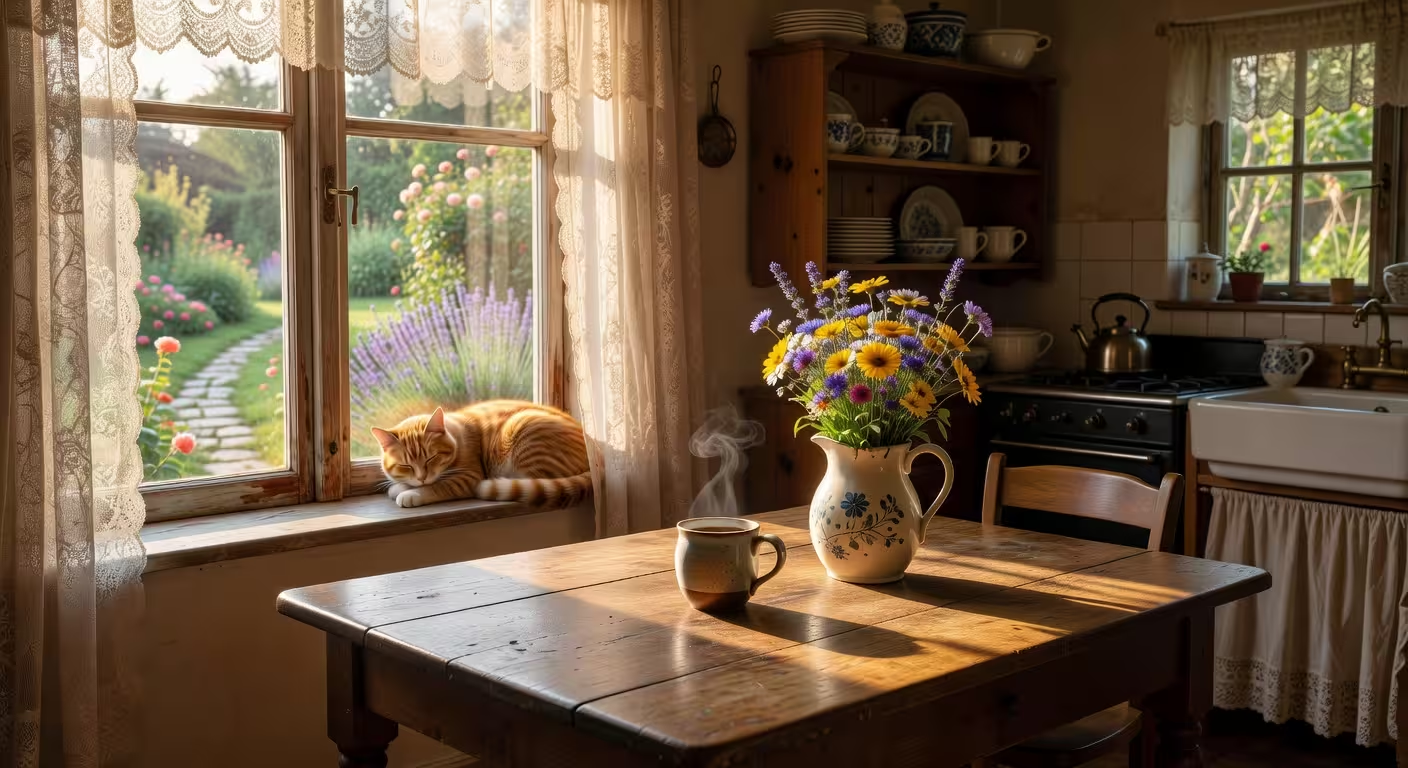
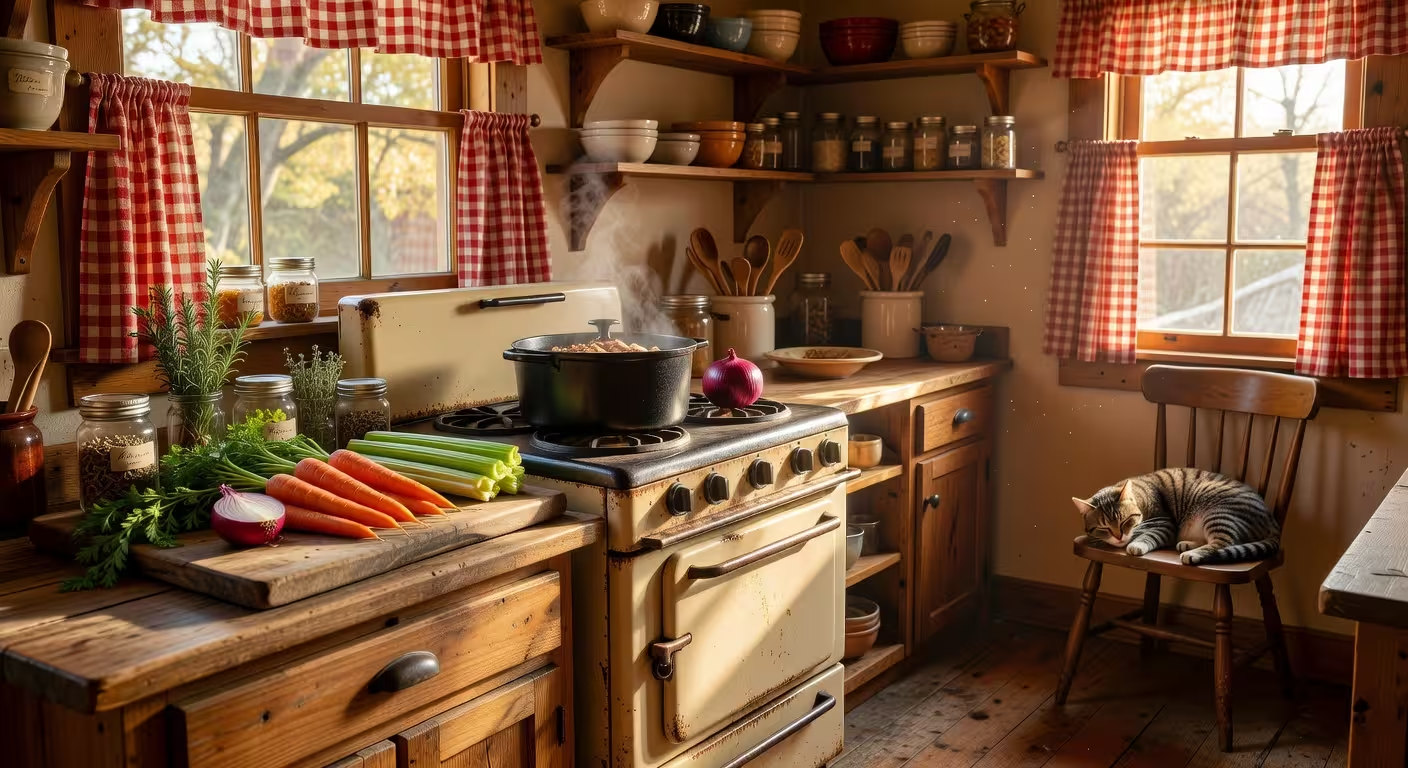
Traditional wife arranging fresh flowers in her cottage kitchen while wearing a vintage apron

2018

Movement begins online

6B+

TikTok views on #tradwife

50%

Of influencers are non-white
(UH 2025 study)

30+

Countries with active communities

Chapter 1

What Is a Tradwife?

A tradwife is a woman who chooses to embrace traditional gender roles — placing homemaking, raising children, and supporting her husband at the center of her life. The word is a combination of “traditional” and “wife,” and it describes both a lifestyle and a growing global community of women.

But let us be clear from the start: being a tradwife is not about being forced into anything. It is not about obedience without voice, or submission without partnership. It is about making a deliberate, intentional choice to build your life around your family and your home — because you believe that is where your greatest impact lies.

The tradwife lifestyle looks different for every woman who lives it. Some are deeply religious. Others are not. Some homeschool their children. Others use public schools and spend their time focused on homemaking and community. Some come from conservative backgrounds. Others grew up in progressive homes and found their way here through their own experience. As Australian historian Kristy Campion of Charles Sturt University has noted, for many women, this is simply a personal choice unconnected to any specific ideology (ABC News, 2021).

What unites tradwives is not a political position or a religious affiliation — it is the shared conviction that family life, when treated as a vocation, is deeply fulfilling.

“Being a tradwife is not about going backwards. It is about choosing, with full intention, the values that have built strong families for generations.”

If you are reading this because you are curious — welcome. If you are reading this because you already live this way and want to feel less alone — you are in the right place. And if you are reading this because someone told you tradwives are something to be worried about — stay with us. The reality is far more nuanced, and far more human, than headlines suggest.

Chapter 2

Tradwife Meaning & Origin of the Term

The word “tradwife” is a portmanteau — a blend of “traditional” and “wife.” Researchers Sophia Sykes and Veronica Hopner, in their peer-reviewed 2024 study published in the Journal of Contemporary Ethnography, define tradwives as “right-wing social media influencers” who promote traditional gender roles — though, as we will see, that academic framing captures only one dimension of a much broader movement.

The term gained mainstream visibility in the early 2020s as creators like Nara Smith, Hannah Neeleman (known for Ballerina Farm), and British writer Alena Kate Pettitt attracted millions of followers on TikTok, Instagram, and YouTube. Pettitt, one of the earliest voices in the movement, gained widespread attention during a January 2020 BBC interview where she spoke openly about her desire to serve her husband and prioritize homemaking. She later authored two books on the subject.

But the idea of a traditional wife is, of course, not new. What changed in the 2020s was that women who had been living this way quietly — sometimes feeling isolated in a culture that seemed to celebrate only career achievement — suddenly found each other online. The hashtag #tradwife gave a name to something that had always existed, and it created a community where there had only been individuals.

It is worth noting that many women who live traditionally do not use the term “tradwife” at all. Some prefer “homemaker,” “stay-at-home wife,” or simply “traditional.” Among Black communities, for instance, the framing is often around “biblical marriage” or “submissive wife” rather than the tradwife label specifically, as Refinery29 reported in 2022. The lifestyle is broader than any single word.

Chapter 3

A Brief History of the Tradwife Movement

1950s

The idealized housewife era

Postwar prosperity in the United States creates the iconic image of the stay-at-home wife: matching appliances, suburban homes, a husband greeted at the door. This image — both celebrated and later criticized — becomes the visual shorthand for “traditional” domestic life.

1960s–1990s

Feminism challenges traditional roles

Second- and third-wave feminism open career opportunities for women. Homemaking becomes culturally devalued in many circles. Millions of women continue choosing it — but often feel they have to justify the decision.

2013–2017

The girlboss era peaks

Sophia Amoruso’s 2014 book #Girlboss and the broader Lean In culture dominate social media. Empowerment is framed almost exclusively as career achievement. Many women begin to feel the weight of an impossible double standard. Scholars note the concept prioritizes individual success over systemic change.

2018–2019

The tradwife movement forms online

Blogs, forums, and early YouTube channels begin connecting women who embrace traditional roles. Alena Kate Pettitt’s “The Darling Academy” is a landmark. The word “tradwife” starts circulating on platforms including Reddit and 4chan, though with varying connotations.

January 2020

BBC interview brings mainstream attention

Alena Kate Pettitt’s BBC News interview introduces the concept to mass audiences. The Guardian, The Sydney Morning Herald, and other major outlets publish tradwife features within weeks. The term enters public debate.

2021–2023

TikTok explosion

Short-form video transforms the movement. “A day in my life” homemaking videos go viral. Nara Smith’s from-scratch cooking and Hannah Neeleman’s Ballerina Farm become cultural touchstones. #tradwife accumulates billions of views. Academic researchers begin studying the phenomenon: Eviane Leidig publishes The Women of the Far Right (Columbia University Press, 2023).

2024

Mainstream media peak

The New York Times Magazine and The New Yorker publish major features. Pettitt tells The New Yorker the trend has “become its own monster.” Time publishes historian Marissa C. Rhodes’ analysis of how influencers misrepresent 19th-century women’s lives.

February 2025

The Patriarchy Hannah controversy

Tradwife influencer “Patriarchy Hannah” is exposed for fabricating her persona — she was not, as she had claimed, a married mother of 14. The incident sparks a broader conversation about authenticity in the movement (USA Today, Feb 2025).

April 2025

Academic research matures

A University of Hawaiʻi study sampling 61 TikTok tradwife influencers finds that approximately half are non-white, and that anti-feminism is the only consistent ideological thread. The study challenges the narrative that the movement is exclusively white or politically extreme.

Where the movement is today

Today, the tradwife community is global, diverse, and still growing. It includes women from different countries, different races, different religions, and different economic backgrounds. What started as a niche internet subculture has become a genuine lifestyle movement — with communities like Tradwife Club providing spaces for connection that go beyond social media algorithms.

Chapter 4

What Tradwives Actually Believe

The tradwife lifestyle is built on a handful of core convictions. Not every tradwife would express them in exactly the same way, but these are the values that come up again and again in our community:

Family comes first

Not as a slogan, but as a daily practice. Decisions about time, money, career, and lifestyle all flow from the question: what is best for our family?

The home is a vocation, not a fallback

Running a home and raising children is skilled, demanding, valuable work. Tradwives reject the idea that homemaking is something you do because you “could not” do something else. As The Sydney Morning Herald noted, the tradwife movement is partly about reclaiming leisure and presence in a world where working mothers face a relentless double burden.

Partnership, not hierarchy

A traditional marriage is a team with complementary roles. The tradhusband provides and protects; the tradwife nurtures and manages the home. Different responsibilities, equal value.

Intentional living

Cooking from scratch, creating routines, slowing down — not because it is trendy, but because it creates a home your family actually wants to be in.

Choice is the foundation

No woman should be forced into the home. And no woman should be shamed for choosing it. The tradwife lifestyle is rooted in voluntary, informed, joyful choice.

Faith matters — for many, not all

Many tradwives draw strength from their faith — Christian, Catholic, or otherwise. Some Catholic tradwives have adopted the practice of wearing veils at mass as an act of reverence. But the community also includes women whose motivation is entirely cultural, philosophical, or personal. There is no religious requirement.

Chapter 5

Daily Life as a Tradwife

This is the part that social media rarely shows accurately. Being a tradwife is not an endless loop of artfully filmed sourdough rising in golden afternoon light. It is real work — physically, mentally, and emotionally.

The real work

A typical day involves cooking multiple meals from scratch, cleaning, laundry, grocery shopping, managing household schedules, caring for children (and often homeschooling them), maintaining the home, budgeting, and the thousand small decisions that keep a family running. It also involves significant emotional labor: being the person who remembers, plans, comforts, and holds the family together.

As researcher Isabel Sykes documented in the European Journal of Cultural Studies (2025), the performances of tradwives on social media rarely display the tedious and difficult labor that goes into being a stay-at-home parent. The nature of social media creates an environment where the content circulated is an idealized and carefully curated image.

This is not easy work. It is not simple work. And it is not work that “anyone can do.” Experienced homemakers develop real skills in time management, nutrition, budgeting, child development, and domestic logistics that rival any professional skill set.

What makes it worth it

Ask a tradwife why she does it, and the answers tend to center on the same themes: presence, purpose, and peace. Being there when your child takes their first steps — not hearing about it from a caregiver. Sitting down to a dinner you made from scratch, together. Building a home that feels like a sanctuary, not a pit stop between obligations.

It is not a perfect life. Toddlers still have meltdowns. Dinners still burn. Marriage still takes work. But for women who have chosen this path, the trade-offs are worth it — not because the work is glamorous, but because the life it creates is meaningful.

For a practical guide to building this life step by step, see our Tradwife Rules.

Chapter 6

The Tradwife Aesthetic

The tradwife aesthetic is one of the most visible parts of the movement — and one of the most misunderstood. As The New York Times Magazine explored in its August 2024 cover story, the image of “women who dress up as 1950s homemakers” has captivated and polarized the internet in equal measure.

Fashion and personal style

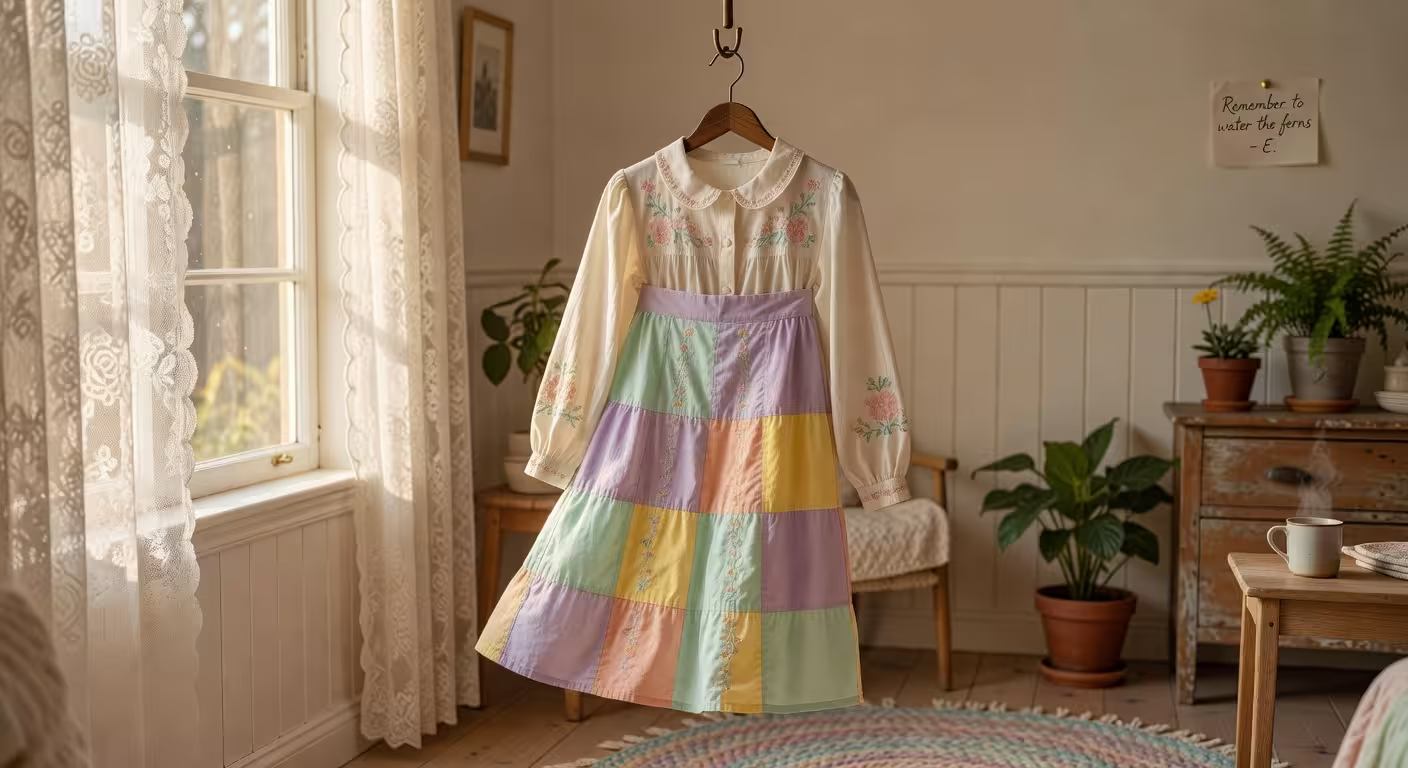
Many tradwives gravitate toward feminine, modest clothing: dresses, skirts, aprons, soft fabrics, and vintage-inspired pieces. But the aesthetic is not one-size-fits-all. Some lean into the 1950s housewife look. Others prefer cottagecore, homestead, or prairie style. Some dress simply and practically. Cultural background plays a significant role — the aesthetic draws from influences as varied as American mid-century culture, neopaganism, and Christian religious values (Hu, Dissent, 2023).

Home and decor

The tradwife home often reflects warmth, comfort, and beauty. Pastel kitchens, vintage cookware, fresh flowers, and handmade touches are common. The tradwife aesthetic has a significant influence on home decorating, ranging from farmhouse to cottage to mid-century to minimalist. Some prefer a back-to-nature appearance over the retro look.

Aesthetic vs. reality

Here is something important: the aesthetic is not the lifestyle. You can wear a vintage dress and still be miserable in your marriage. You can wear jeans and a T-shirt and be the most fulfilled tradwife on your street. The aesthetic is fun, it is creative, and it can be an expression of your values — but it is not the substance. The substance is how you live, not how you look while doing it.

For more on style, outfits, and inspiration, visit our Tradwife Aesthetic guide.

Chapter 7

Notable Tradwives & Influencers

The tradwife movement has no single leader. But several women have shaped public understanding of the lifestyle — for better and for worse. Here are the most influential figures.

Alena Kate Pettitt 🇬🇧

Pioneer · Author · “The Darling Academy”

Often considered the originator of the modern tradwife movement. Pettitt’s 2020 BBC interview was the first time many people heard the term. She has written two books on traditional homemaking. In a 2024 New Yorker profile, she expressed concern that the movement she helped inspire had “become its own monster.” In 2020, she publicly pushed back against media linking all tradwives to extremism, calling it a “smear campaign.”

Hannah Neeleman 🇺🇸

Ballerina Farm · Mother of 8 · “Queen of the Tradwives”

A former Juilliard ballerina, Neeleman runs Ballerina Farm in Utah with her husband Daniel (son of JetBlue founder David Neeleman). With over 9 million followers across platforms, she is among the most visible tradwife figures. She was called the “Queen of the Tradwives” by The Times of London (2024). Notably, Neeleman is co-CEO of the family business — a fact that complicates the single-income narrative, as The New York Times reported.

Nara Smith 🇺🇸🇿🇦🇩🇪

Model · From-scratch cooking creator

A South African–German model based in the US, Smith became one of TikTok’s biggest creators with her distinctively calm, from-scratch cooking videos — making everything from cereal to gummy bears at home. As a biracial woman, her popularity has helped challenge the assumption that the tradwife aesthetic is exclusively white. She is also a professional model, which, like Neeleman, adds complexity to the “stay-at-home” framing.

“Patriarchy Hannah” 🇺🇸

Controversy · Cautionary tale

In February 2025, this popular tradwife influencer was exposed by NBC News for fabricating her entire persona — she was not the ultraconservative married mother of 14 she had claimed to be. The controversy was a wake-up call for the community about the risks of building identity around unverified social media personas. It underscored why real community matters more than parasocial influencer relationships.

Seyward Darby 🇺🇸

Journalist · Author of Sisters in Hate

Not a tradwife herself, but an important voice in the conversation. Darby’s 2020 book Sisters in Hate: American Women and White Extremism explored the overlap between the tradwife aesthetic and the American far right, documenting how some women in the movement espoused white supremacy, antisemitism, and ultraconservatism. Her work is a necessary — if sometimes uncomfortable — part of understanding the full spectrum of the movement.

For a complete list of tradwife creators across platforms, visit our Tradwife Influencers guide.

Chapter 8

Who Are Tradwives, Really?

One of the biggest misconceptions about the tradwife movement is that it is exclusively white, wealthy, Christian, and politically far-right. The data tells a different story.

Racial and cultural diversity

A 2025 University of Hawaiʻi study sampled 61 tradwife influencers on TikTok and found that approximately half were white and approximately half were not. The tradwife lifestyle resonates across racial and cultural lines because the desire for family-centered living is not exclusive to any one group.

Within Black communities, a growing number of women have embraced traditional marriage — often framing it as liberation from overwork and economic stress. As Refinery29 reported in December 2022, these women argue that traditional marriage is a path to escaping burnout and economic insecurity, though they typically use the language of “biblical” or “submissive” marriage rather than the tradwife label. Within Hispanic, Asian, and other communities, traditional family values have deep cultural roots that predate any internet trend.

Economic backgrounds

Tradwives come from every economic bracket. Some live on single incomes that require careful budgeting. Others have more financial freedom. The idea that you need to be wealthy to be a tradwife is partly fueled by the polished social media presence of high-profile influencers — but it does not reflect the reality of most women in the community.

Political and religious range

While the tradwife movement skews conservative, it is not politically monolithic. Researchers Sykes and Hopner identified a wide range of political views among tradwives, which, while primarily conservative, range from moderate to extreme. The UH 2025 study found that anti-feminism was the only consistent ideological thread — not political affiliation, not religious belief, and not racial identity.

Historian Kristy Campion has explicitly cautioned against “denouncing all tradwives as far-right extremists,” saying that for many women, this is a personal choice unconnected to a specific ideology.

Chapter 9

Tradwives and Feminism

This is probably the most debated aspect of the tradwife lifestyle, so let us address it honestly.

The relationship between tradwives and feminism is complicated. Some tradwives identify as anti-feminist. Some see themselves as exercising the very choice that feminism fought to give them. And some simply do not think about it in those terms at all. The 2025 UH study found that anti-feminism was the only consistent ideological thread among tradwife influencers — but even that manifests in very different ways, from mild skepticism to outright opposition.

The “girlboss” exhaustion

The tradwife movement grew partly in response to what many women experienced as the failure of “girlboss” feminism — the idea, popularized in the 2010s, that empowerment meant climbing corporate ladders, leaning in, and proving you could do everything a man could (while also being a perfect mother and partner). Scholars Janice Byrne and Antonio Paco Giuliani, writing in the Journal of Business Venturing (2025), documented how the girlboss concept evolved from empowerment into a symbol of narrow, individualistic White feminism.

For many women, the tradwife path is not a rejection of women’s rights. It is a rejection of the specific pressure to find fulfillment primarily through career achievement. It is the recognition that choosing family over career is a legitimate, worthy choice — not a step backward.

The feminist critique

Critics from within feminism argue that the tradwife movement risks normalizing dependence, that it romanticizes an era when women had far fewer rights, and that social media tradwives may inadvertently discourage women from maintaining financial independence. Scholars Catherine Rottenberg and Shani Orgad, writing in The Conversation (2020), argued that tradwives are “grounded in the neoliberal present” even as they look to the past.

These are real concerns, and they deserve honest engagement — not dismissal. Financial literacy, open communication, and mutual respect within a marriage are important regardless of who earns the income. Any version of traditional living that leaves a woman unable to care for herself and her children if circumstances change is not traditional — it is dangerous.

Our position

At Tradwife Club, we believe that true empowerment means having the freedom to choose the life that is right for you — including the choice to be a homemaker. We also believe that choice should be informed, that women in traditional marriages should have access to financial knowledge and safety, and that the strength of a traditional family comes from genuine partnership, not from one person’s subordination.

Chapter 10

Common Criticisms — and Our Perspective

We would rather address criticism head-on than pretend it does not exist. Here are the most common objections, the evidence behind them, and how we think about them.

“Tradwives promote far-right ideology”

Some individuals within the movement have been connected to far-right views. Journalist Seyward Darby documented this in Sisters in Hate (2020), and researcher Eviane Leidig explored it further in The Women of the Far Right (2023). We do not deny this overlap exists. But the 2025 UH study found that political extremism was not a consistent feature of the movement, and Kristy Campion has explicitly warned against generalizing the politics of all tradwives. British journalist Hadley Freeman wrote in The Guardian that the concept is “especially popular among white supremacists” — but popular among a group is not the same as defined by that group.

“Social media tradwives are not being honest”

This is partly true — and it is a problem we take seriously. History professor Marissa C. Rhodes wrote in Time (2024) that many tradwife influencers promote incorrect ideas about how women actually lived in earlier centuries. The Patriarchy Hannah scandal (February 2025) showed the real risks of inauthenticity. We believe the answer is more honesty, not less — which is why real community spaces matter more than any influencer’s feed.

“Tradwife influencers earn money while telling others not to work”

This is one of the most valid criticisms. Nara Smith is a professional model. Hannah Neeleman is co-CEO of Ballerina Farm. Many influencers monetize through brand deals, merchandise, and affiliate marketing (Leidig, 2023). As The New York Times reported, these influencers cannot be compared to the homemakers of the 1950s, who were unable to have credit cards in their own names. Honest conversation about the real economics of single-income families is essential.

“It romanticizes the 1950s”

The 1950s aesthetic is popular, but most tradwives are not trying to recreate 1959. They are taking what was good — family meals, homemaking skills, presence — and leaving behind what was not. No serious tradwife wants to go back to a time when women could not open their own bank account or when racial segregation was law.

“It is only for privileged women”

Living on a single income requires financial planning, and it is easier for higher-income families. But millions of families worldwide make it work through careful budgeting. The polished images on social media skew perception. A 2020 Washington Post analysis noted that one key aspect of the tradwife appeal is the promise of reclaiming leisure time in a world where women — especially mothers — who earn an income face a relentless double burden.

Chapter 11

Tradwives on Social Media

Social media is where most people first encounter the tradwife movement, and it is both the movement’s greatest asset and its biggest source of misunderstanding.

The platforms

TikTok is the dominant platform, with billions of views on #tradwife. Instagram and YouTube are also widely used. Platforms like Reddit and 4chan have been used to promote traditional heterosexual relationships since before the term “tradwife” existed (Sykes & Hopner, 2024). “A day in my life” videos, cooking-from-scratch tutorials, and homemaking routines are the most popular content formats.

The algorithm problem

Research by Media Matters has found that viewers of tradwife content are often algorithmically recommended conspiracy theory content — not because tradwives promote conspiracies, but because recommendation algorithms group conservative-leaning content together indiscriminately. As New York Times columnist Jessica Grose noted, much tradwife content is not even primarily consumed by women — it is consumed by men who want submissive wives. This is a platform design problem with real consequences for how the movement is perceived.

The gap between content and reality

Social media always shows a highlight reel. The cooking looks effortless. The house is always clean. The children are always well-behaved. Researcher Devin Proctor (2022) studied how the #tradwife persona functions on social media, documenting the gap between curated performance and lived reality. Real life involves burnt meals, messy kitchens, exhausting days, and moments of doubt.

Beyond social media

The tradwife movement is sometimes described as a “social media subculture,” but that framing is increasingly incomplete. It is a lifestyle that millions of women live offline, without ever posting about it. The internet gave it a name and a community. But the life itself happens in kitchens, at dinner tables, and in homes — not on screens. That is precisely why offline and community-based spaces like Tradwife Club matter.

For profiles of women leading the conversation online, see our Tradwife Influencers guide.

Chapter 12

The Financial Reality

Money is one of the least discussed but most important aspects of the tradwife lifestyle. Let us talk about it honestly.

How single-income families work

In many tradwife households, the husband manages broader financial planning while the wife manages the day-to-day household budget — groceries, household supplies, children’s needs. This was documented by Woman & Home (2020) and Heart Radio (2020) in early profiles of the movement. This division works well for many couples, but it requires trust, transparency, and open communication about finances.

The influencer paradox

Here is an uncomfortable truth: many visible tradwife influencers earn significant income from their content — through brand deals, merchandise, and affiliate marketing. Researcher Eviane Leidig catalogued these monetization strategies in The Women of the Far Right. Hannah Neeleman is co-CEO of a business. Nara Smith is a professional model. They are not, financially speaking, living the single-income life they appear to portray.

This does not make their content worthless, but it means their version of the lifestyle is not directly replicable for women whose families genuinely live on one income. Honest financial conversation — about budgeting, saving, planning for emergencies, and maintaining financial literacy — is far more useful than aesthetic aspiration.

Financial safety

We believe strongly that every woman in a traditional marriage should understand her family’s finances, have access to family accounts, and be capable of supporting herself and her children if circumstances change. Financial dependence by choice is different from financial ignorance, and the tradwife community is strongest when it encourages both trust and preparedness.

Chapter 13

Tradwife vs. Girlboss: Understanding the Shift

The tradwife movement cannot be understood without understanding what it rose against. The “girlboss” phenomenon — popularized on Tumblr and Instagram in the mid-2010s — promised women empowerment through entrepreneurship and career achievement.

Tradwife Girlboss
Core value Family and home Career and independence
Measure of success Quality of family life Professional achievement and wealth
View of work Homemaking is the primary work Paid career is the primary work
Criticized for Romanticizing dependence Ignoring systemic inequality
Peak era 2021–present 2014–2019
Blind spot Financial vulnerability Burnout and double burden

As scholars Byrne and Giuliani argued in the Journal of Business Venturing (2025), the girlboss concept evolved from genuine empowerment into a narrow form of White feminism that prioritized individual success without challenging the underlying structures of power. The tradwife movement emerged partly as a counterculture response — advocating for values like family, stability, and community over the individualistic and entrepreneurial ideals of the girlboss era (NYT, 2024).

The reality, of course, is that most women do not fit neatly into either category. Life is more complex than an internet label. But understanding the cultural tension between these two poles helps explain why the tradwife movement has resonated so deeply with so many women.

Chapter 14

How to Start Living Traditionally

If the tradwife lifestyle resonates with you, here is the honest truth: you do not need a farmhouse, a vintage wardrobe, or a picture-perfect kitchen to start. You need a conversation with your partner and a willingness to build intentionally.

1. Start with a conversation

Talk to your partner about what you both want your family life to look like. What are your values? What roles feel natural? What would need to change financially? This is a joint decision, not a solo one.

2. Get your finances clear

Before transitioning to a single income, know your numbers. What does your family spend? What can you cut? What is your emergency fund? Financial clarity removes the biggest source of stress in any lifestyle change.

3. Build skills gradually

You do not need to become a from-scratch cook overnight. Start with one or two homemade meals a week. Develop a cleaning routine. Learn to menu plan. These are skills, and like any skill, they take time. Our Tradwife Rules guide breaks this down practically.

4. Ignore the aesthetic pressure

You do not need a vintage dress to be a tradwife. You need purpose, presence, and partnership. The aesthetic is fun, but it is optional. Do not let Instagram standards make you feel like you are not “traditional enough.”

5. Find your community

One of the hardest parts of living traditionally in a modern world is the loneliness. Your friends may not understand your choices. Social media may leave you feeling inadequate. A real community — where you can ask honest questions and get real answers — changes everything.

That is exactly why Tradwife Club exists.

References

Sources & Further Reading

This guide cites peer-reviewed research, major news outlets, and published books. We believe transparency about sources builds trust.

Academic research

Books

  • Leidig, E. (2023). The Women of the Far Right: Social Media Influencers and Online Radicalization. Columbia University Press. Publisher link
  • Darby, S. (2020). Sisters in Hate: American Women and White Extremism. Little, Brown. Publisher link

Major news coverage

  • Wang, A. X. (Aug 2024). “Who’s Afraid of the Big, Bad Tradwife?” The New York Times Magazine
  • Elmhirst, S. (Mar 2024). “The Rise and Fall of the Trad Wife.” The New Yorker
  • Moskin, J. (Dec 2024). “Tycoon or Tradwife? The Woman Behind Ballerina Farm.” The New York Times
  • Rhodes, M. C. (Oct 2024). “#Tradwife Influencers Totally Misunderstand the Lives of 19th Century Women.” Time
  • Brown, R. (Jan 2020). “‘Submitting to my husband like it’s 1959.'” BBC News
  • Freeman, H. (Jan 2020). “‘Tradwives’: the new trend for submissive women has a dark heart.” The Guardian
  • Burton, N. (Dec 2022). “Black ‘Tradwives’ Say Marriage Is The Key To Escaping Burnout.” Refinery29
  • Ordonio, C. (Apr 2025). “UH study explores how social media’s ‘tradwives’ view feminism.” Hawaiʻi Public Radio
  • Rosenblatt, K. (Feb 2025). “Tradwife account ‘Patriarchy Hannah’ apologizes for lies.” NBC News

You do not have to do this alone

Join Thousands of Traditional Families

Tradwife Club is the only community built from the ground up for women and families who have chosen this path. Share recipes, get real advice, talk honestly about marriage and parenting, and find the people who celebrate your choices instead of questioning them.

Join Tradwife Club Free

Stay connected

Get Weekly Inspiration

Every Monday: one recipe worth trying, one homemaking tip that actually works, and one reminder that the life you are building matters more than the world gives it credit for.

Subscribe Free